
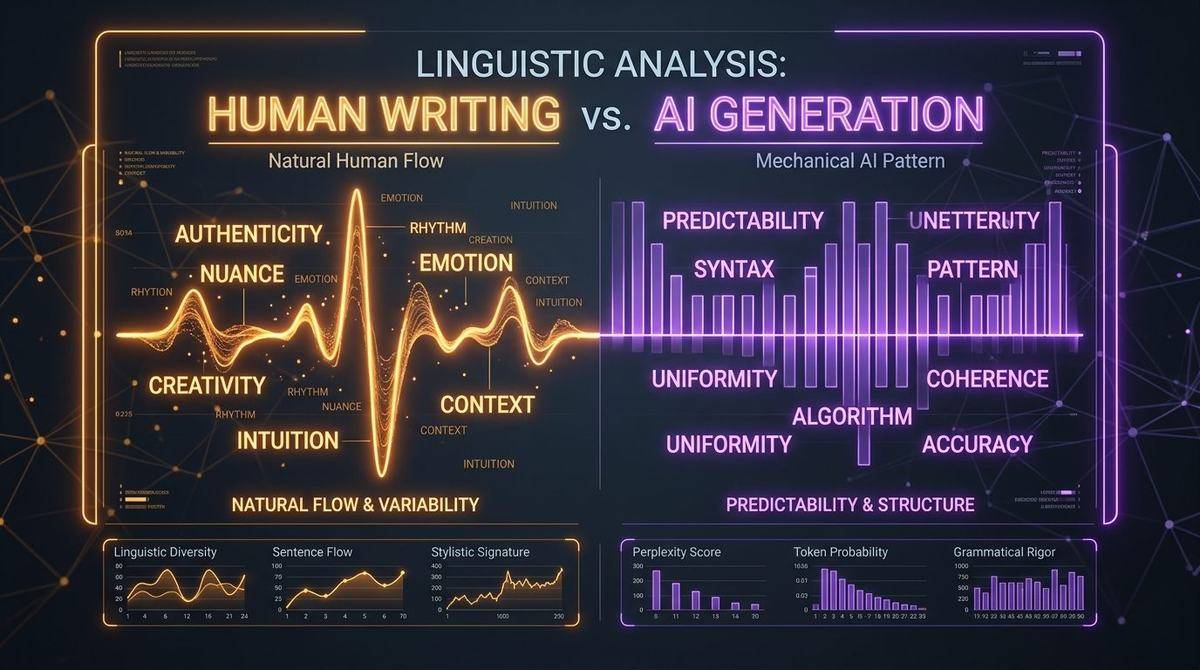
Burstiness: Sentence-Length Variation (CV)
In quantitative stylometry, burstiness (measured in OriginSift via the Coefficient of Variation of sentence length, $CV = \sigma / \mu$) describes how much sentence length and clause architecture vary across a multi-paragraph passage.
🫀 Varied Pacing (High Burstiness)
Expressive human writing naturally alternates short punchy sentences with longer, multi-clause explanations and parenthetical observations.
🤖 Uniform Pacing (Low Burstiness)
Default LLM outputs frequently produce sentences of very similar length (around 16 to 22 words), often joined by a participial clause in the middle.
Count the words in 5 consecutive sentences. If every sentence is roughly 15–22 words long with identical clause structure, the passage has low burstiness. Note that style metrics alone are never proof of AI authorship—formal academic abstracts, standard operating procedures, and ESL writing can also have very uniform sentence lengths.
Perplexity: Measuring Word Predictability
Perplexity measures how predictable a sequence of tokens is to a reference causal language model (such as DistilGPT-2 in OriginSift). Mathematically, perplexity is the exponentiated average negative log-likelihood of each next token given its preceding context.
Imagine finishing the sentence: "The weather outside was surprisingly..."
- Default language model decoding gravitates toward high-probability continuations like "cold", "warm", or "mild" because autoregressive sampling favors the mode of the probability distribution.
- Idiosyncratic human writing often uses less predictable phrasing like "sticky", "soup-like", or concrete sensory details anchored in lived experience.
Formulaic Stock Phrases: Why Do Chatbots Overuse 'Delve' & 'Tapestry'?
Unedited AI-assisted drafts frequently repeat a familiar cluster of transition phrases and metaphors:
Why does this happen? During instruction tuning and Reinforcement Learning from Human Feedback (RLHF), human annotators frequently reward polite, hedged, five-paragraph essay templates that sound authoritative and diplomatic. Over thousands of gradient updates, models internalize transitions like "Moreover," "Furthermore," "It is worth noting," and metaphors like "intricate tapestry" as safe, high-reward connectors.
Beyond Black-Box Scores: Document Provenance + Writing Style Coach
Opaque "AI detectors" output a single percentage without showing which sentences triggered it—an approach that is scientifically unreliable and unfair to students, journalists, and non-native English writers.
OriginSift approaches text and documents through the Open Glass-Box Workbench (Reveal → Recover → Refine):
Reveal (Style, Perplexity & Multi-Window Triage):
Measures sentence-length CV, Moving-Average Type-Token Ratio (MATTR) vocabulary variety, stock phrase density, DistilGPT-2 token perplexity, and 320-word sliding-window neural text classification.
Recover (DOCX & PDF Container Provenance):
When you upload a .docx or .pdf file, OriginSift inspects OpenXML revision counts (cp:revision), logged editing minutes (TotalTime), authoring software, and PDF incremental save markers (%%EOF) alongside the text itself.
Refine (Writing Style Coach):
Highlights exact stock phrases and overly long sentences with plain-English rewrite suggestions to make your draft clearer and more specific—without pretending to be an adversarial "detector bypasser."
"In today's fast-paced digital landscape, it is crucial to delve into the rich tapestry of modern communication, which serves as a testament to human innovation."
"How we talk online changes fast. If you examine digital conversations, you can see how much our everyday language has adapted."
Inspect Writing, Documents & Media with Our Standalone AI Detectors
Paste prose, drop a Word (.docx) or PDF file, or test accompanying images and videos in our dedicated workbenches:


Related Field Guides & Blog Articles
Explore our companion visual guides on EXIF camera metadata and viral AI photo giveaways:
 📷 EXIF & Camera Guide
 📸 Visual Field Guide